From The Edge of Sports Website
Redeeming the Olympic Martyrs of 1968
By Dave Zirin
1968. There was never a year when the worlds of sports and politics collided so breathlessly, without mercy or respite. It was the year Muhammad Ali, stripped of his heavyweight title for resisting the draft, spoke on 200 college campuses and asked the question, “Can they take my title without me being whupped?” It was the year Bill Russell’s Boston Celtics became champions once again, yet the player-coach saw his house vandalized by bigots. This led Russell to call the city of Boston a “flea market of racism,” and say “I am a Celtic, not a BOSTON Celtic.” It was the year the Detroit Tigers won the World Series, playing in a city that carried the specter of insurrection with riots in the hood, snipers on the roofs, wildcat strikes in the auto plants, and Martha and the Vandellas’ “Dancing in the Streets” ringing throughout the projects.
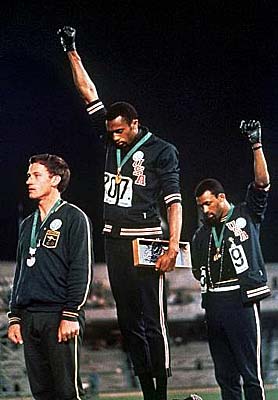
And most famously, it was the year that Tommie Smith and John Carlos took the 200-meter medal stand at the Mexico City Olympics to raise their black gloved fists in a demonstration of pride, power, and politics. Smith and Carlos were part of the Olympic Project for Human Rights (OPHR) and they made their stand because of what was happening outside the stadium: the assassination of Dr. Martin Luther King; the growth of the Black Panthers, the May strikes in France, and most recently in their thoughts, the slaughter of hundreds in the country where they were being feted with gold.
On October 2, 1968, right before the start of the games, Mexican Security police murdered as many as 400 students and workers at La Plaza de las Tres Culturas in Tlatelolco, Mexico City. Today we remember that violent echo of 1968. We remember those put down like dogs for the crime of peaceful assembly. We can remember at long last, without tears, because of news Monday that a measure of closure may finally be coming for the families that have waged a 37-year quest for truth, justice, and a pound of flesh. Mexican prosecutors announced that they were finally acceding to a four-decades-long campaign, and filed long-awaited charges against former President Luis Echeverria for ordering the Tlatelolco bloodbath. Echeverria was interior minister and head of national security at the time of the massacre. “It has been almost 37 years of impunity and justice denied,” prosecutor Ignacio Carrillo told Reuters. “Now for the first time it is possible that the justice system may perform its duty.” The Tlatelolco killings were fatally intertwined with the oncoming Olympics. Student strikes had rocked Mexico throughout the year. This was a time of mass struggle from the Yucatan to Tijuana. But the students and their supporters, despite previous clashes with the state police, could not have foreseen the fanatical desire of Mexico to “make their country secure” for the coming Olympic games.
Echeverria’s Olympic clean-up, not the actions of panicked police, rogue officers, or indiscriminate trigger happy shooters, were responsible for the deaths. Recently declassified documents paint a picture of a massacre as cold and methodical as Echeverria’s instructions, and the blood in his veins. As Kate Doyle, director of the Mexico Documentation Project describes, ”When the shooting stopped, hundreds of people lay dead or wounded, as Army and police forces seized surviving protesters and dragged them away. Although months of nationwide student strikes had prompted an increasingly hard-line response,…no one was prepared for the bloodbath that Tlatelolco became. More shocking still was the cover-up that kicked in as soon as the smoke cleared. Eye-witnesses to the killings pointed to the President’s ‘security’ forces, who entered the plaza bristling with weapons, backed by armored vehicles. But the government pointed back, claiming that extremists and communist agitators had initiated the violence. Who was responsible for Tlatelolco? The Mexican people have been demanding an answer ever since.”
Thousands of people have marched in the streets every year demanding justice for what is seen as Mexico’s Tiananmen Square. And while it is certainly welcome to see Echeverria doddering in cuffs, this arrest should not be seen only as an epilogue of the past but a warning for the future. The Beijing Olympics in 2008 and the British Olympics of 2012 both hold the potential for crackdowns that could make Tlatelolco seem mild in comparison. At the very least in China, where human rights and trade union organizing are a daily battle in normal times, the Olympics will hit those struggles with the force of a hurricane (a metaphor I don’t use lightly.) We need today to organize a new Olympic Project for Human Rights so people in China who want to resist the corporate monolith and state repression which trail after the Olympics like so much detritus, have the political space to do so. It would be a true, living justice, if the martyrs of 1968 can be resurrected to haunt a new generation of Echeverrias already planning security operations in Beijing.
1968: The Year of the Fist
By Dave Zirin
“It was inevitable that this revolt of the black athlete should develop. With struggles being waged by black people in the areas of education, housing employment and many others, it was only a matter of time before Afro-American athletes shed their fantasies and delusions and asserted their manhood and faced the facts of their existence..”
Dr. Harry Edwards
It has been 35 years since a son of a migrant worker named Tommy Smith and Harlem’s John Carlos took the medal stand at the 1968 Olympics and created what is arguably the most enduring image in sports history. But while the image has stood the test of time, the politics that led to that moment has been cast aside by capitalism’s commitment to political amnesia; its political teeth extracted.
Smith and Carlos’s stunning gesture of revolt and resistance was not the product of some spontaneous urge to get face time on the evening news, but was a product of the black athletes’ revolt in the 1960s.
In the fall of 1967 amateur black athletes formed OPHR Olympic Project for Human Rights to organize a boycott of the 1968 Olympics in Mexico City.
OPHR, and its lead organizer Dr. Harry Edwards, was very influenced by the Black Freedom struggle. It’s goal was to expose how the US used black athletes to project a lie both at home and internationally.
In their founding statement they wrote,
“We must no longer allow this country to use a few so called Negroes to point out to the world how much progress she has made in solving her racial problems when the oppression of Afro-Americans in is greater than it ever was. We must no longer allow the sports world to pat itself on the back as a citadel of racial justice when the racial injustices of the sports world are infamously legendary… any black person who allows himself to be used in the above matter is a traitor because he allows racist whites the luxury of resting assured that those black people in the ghettos are there because that is where they want to be. So we ask why should we run in Mexico only to crawl home?”
OPHR had three central demands:
1 - “Restore Muhammad Ali’s title.”
Ali’s title had been stripped earlier that year for his resistance to the Viet-Nam draft. By expressing solidarity with Ali, they also were expressing their opposition to the war.
2 - “Remove Avery Brundage as head of the United States Olympic Committee.”
Brundage was a notorious white supremacist who is best remembered today for sealing the deal on Hitler hosting the 1936 Olympics in Berlin.
3 - “Disinvite South Africa and Rhodesia.”
This was a conscious effort to express internationalism with the black freedom struggles occurring in these two apartheid states.
The IOC buckled on the third demand, banning Rhodesia and South Africa. This took the wind out of the sails of a broader boycott. But many athletes were still determined to make a stand.
The lead up to the 1968 Olympics in Mexico City were electric with struggle. Already in 1968 the world had seen the weaknesses of US imperialism at the Tet offensive in Viet-Nam; the Prague Spring, where Czech students challenged the Stalinist tanks, the assassination of Martin Luther King and the mass revolts that followed, the growth of the Black Panther Party in the United States, and the largest general strike in world history in France. Then, On October 2, ten days before the Games opened, the Mexican security forces massacred hundreds of students in Mexico City who were occupying the National University.
Although the harassment and intimidation of athletes supporting OPHR was not even close to the massacre of the students and their supporters, the intention was the same—to stifle protest.
It was on the second day that Smith and Carlos took their stand. First Smith set a world record. Then he took out the gloves. When the silver medallist, a runner from Australia named Peter Norman saw what was happening, he ran into the stands to grab an OPHR patch off a supporters’ chest to show his solidarity on the medal stand.
When the U.S. flag began rising up the flagpole and the anthem played, the two men bowed their heads and raised their fists in a black power salute.
But there was more than the gloves. Smith and Carlos also wore no shoes to protest black poverty; and beads to protest lynching.
Within hours, Smith and Carlos were expelled from the Olympic Village and were stripped of their medals. Avery Brundage justified this by saying, “They violated one of the basic principles of the Olympic Games: that politics play no part whatsoever in them.”
The LA Times accused Smith and Carlos of a “Nazi-like salute.”
Time Magazine had the Olympic logo but instead of the motto Faster, Higher, Stronger, had “Angrier, Nastier, Uglier.”
But if they were being attacked from all corners, they received support from unlikely sources.
The Olympic Crew Team, all white and entirely from Harvard, issued a statement:
“We as individuals have been concerned about the place of the black man in American society in their struggle for equal rights. As members of the US Olympic team, each of us has come to feel a moral commitment to support our black teammates in their efforts to dramatize the injustices and inequities which permeate out society.”
OPHR and the actions of Smith and Carlos were a terrific slap in the face to the hypocrisy at the heart of the Olympics. However, there was a deep flaw mirrored in other aspects of the New Left and the Black Power movement in that women were largely shut out. Many of the calls were about reclaiming manhood, as if African-American women weren’t victims of racism or couldn’t be a strong voice against it.
The foolishness of this move was quickly seen because many women athletes were major voices of solidarity after the fact. The anchor of the women’s gold medal wining 4×100 team, Wyomia Tyus said, “I’d like to say that we dedicate our relay win to John Carlos and Tommy Smith.”
It was a watershed moment of resistance. But Carlos and Smith are not merely creatures of nostalgia. As we build resistance today to war, theirs is a living history we should celebrate
As Tommy Smith said recently of his frozen moment, “It’s not something I can lay on my shelf and forget about. My heart and soul are still on that team, and I still believe everything we were trying to fight for in 1968 has not been resolved and will be part of our future. —-
Dave Zirin is the News Editor of the Prince George’s Post in Prince George’s County Maryland, for which he writes the column Edge of Sports. His work can be read at www.edgeofsports.com. To have his column sent to you every week, just e-mail edgeofsports-subscribe@zirin.com.
Contact the author at dave@edgeofsports.com